Tibetan Wool Rugs
About the Tibetian wool
Tibetan wool rugs are made from Changpel wool, a specialty of some breeds of sheep found in Tibetan high lands. This wool is renowned for being rich in lanolin, giving it a supremely soft texture and luxurious feel. Colors and designs make these rugs into a statement, heirloom pieces for your home, along with being incredibly decorative and original. Tibetan wool can increase glamour, texture and interest in any space and suitable for a gamut of interior styles. Apart from the fact that it’s super soft and stylish, wool is also hypoallergenic and has high resistance towards dirt, grease and odors. People assume that wool is always warm and gives off heat, adjusting to the ambient environment, making it warm in cool conditions and cool in warm conditions. Tibetan Wool Rugs
About the making of rugs
Tibetan wool rugs are generally handmade with a knotting method different from other methods of rug making. Nowadays, machines are also used to prepare, but the originality and uniqueness specialties are found in the handmade rugs only. In this method, vertical threads are tied onto the loom and eventually become the rug’s fringe. Horizontal threads are interwoven to create a foundation. Then knots are tied to the vertical threads and then cut and tied again to secure each knot. These are also known as nepelese knotted carpets.These days for contemporary styles the fringes are removed and the rugs are binded from all 4 sides.

About the uniqueness of its design and colors
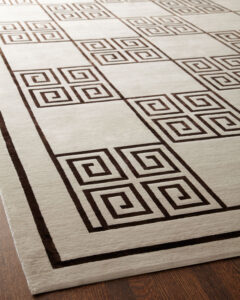
From the 19th century, Tibetan wool rugs are relatively restrained in terms of design and colors. Carpet makers at that time had a limited range of natural colors, including madder (red), indigo (blue), Tibetan rhubarb (yellow) and Tibetan walnut (browns and greys), with a few local plants producing yellow and greenish colors. Originally this art consisted of two classes: the first type is simple geometric designs such as the checkerboard design that probably formed part of an ancient Tibetan design repertoire, mingled with medallion designs and designs inspired by Chinese decorative traditions. From the early 19th century, a vast range of synthetic colors was made available to Tibetan weavers. This had stimulated the production of new and more complex designs, also based loosely on traditional Chinese motifs. The production of several new colorful designs featuring dragons, phoenix, floral motifs, clouds etc., can be found. Though the primary influence was the Chinese, sometimes they also copied western textile designs. These designs in abundance still form the core of the Tibetan weaver’s collection today and make it different and unique compared to others.
From last decade we have observed that in India with indo-tibetan weaving pattern weave we can have almost every design pattern which can be made.
https://www.custom-rugs-custom-carpets.com/

Comments
Post a Comment